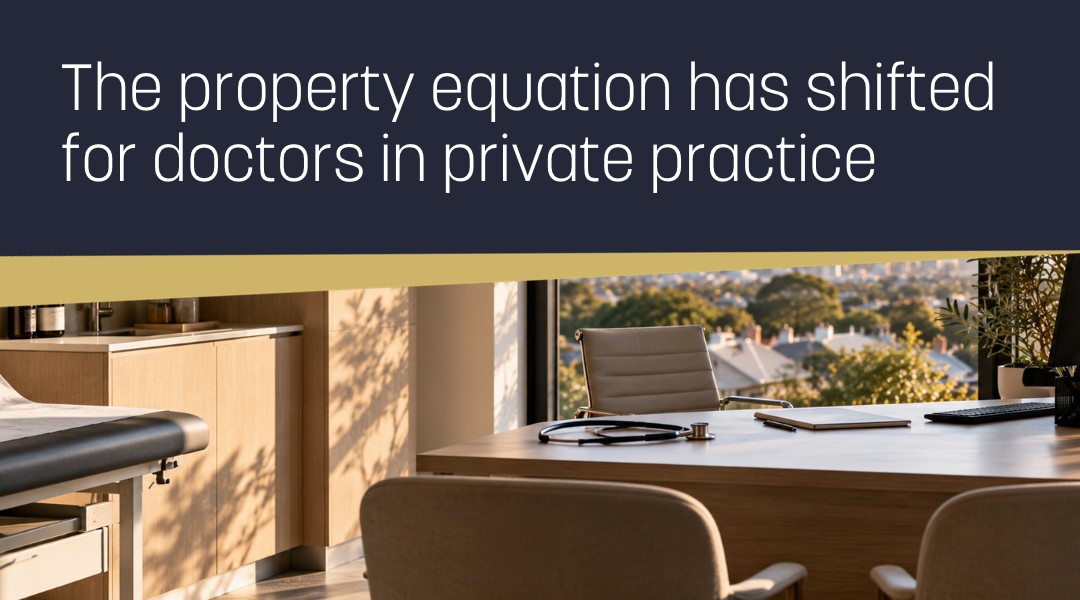
Why changing commercial property conditions are creating opportunities for doctors to secure better premises, negotiate stronger terms and build long-term wealth.
Australia's commercial property market is presenting an interesting opportunity for medical professionals considering establishing, relocating or expanding a private practice.
While much of the conversation around property continues to focus on falling values, higher holding costs and subdued transaction volumes, these same conditions are creating opportunities for well-positioned buyers.
For doctors, particularly those with established income streams and access to finance, this may be one of the more attractive periods in recent years to secure a commercial property for their practice.
The opportunity isn't simply about buying property at a discount. It's about securing a better location, improving the economics of establishing a practice and potentially creating significant long-term wealth through property ownership.
Commercial property owners are facing increasing financial pressure.
Higher interest rates, rising land taxes, insurance premiums and operating expenses have made holding vacant commercial property considerably more expensive.
For an owner with a vacant property, these costs can quickly become unsustainable, particularly when there is no rental income to offset them.
At the same time, many businesses remain cautious about expanding or committing to new premises. This has created a situation where some commercial landlords are finding it increasingly difficult to secure tenants.
The result is a growing number of properties where owners are becoming more motivated to sell or negotiate favourable leasing terms.
In Melbourne, where the commercial property market has experienced a particularly challenging period, we are seeing opportunities that would have been considerably harder to secure several years ago.
For medical professionals looking to establish a practice, this creates an interesting window.
Medical professionals are often in a stronger position than many other businesses when it comes to acquiring commercial property.
Established doctors generally have relatively stable income streams, access to specialist lending products and the ability to support long-term property commitments.
Healthcare is also an essential service, and well-located practices can benefit from recurring patient demand and long-term relationships within their communities.
This doesn't remove the commercial risks associated with establishing a practice, but it can provide doctors with greater flexibility when assessing acquisition and financing opportunities.
Importantly, a medical practitioner purchasing premises for their own business is not necessarily competing on the same terms as a traditional commercial property investor.
An investor generally needs an acceptable rental return from the outset.
An owner-occupying medical practitioner can consider the broader financial benefits of owning the premises, including long-term occupancy security, control over the practice environment and the potential to build equity in the property.
There are two particularly attractive opportunities emerging for medical professionals.
1. Secure a Better Property Within the Same Budget
A doctor who may previously have been limited to a secondary location or a smaller commercial premises could potentially secure a more prominent building, a larger tenancy or a property with better parking and accessibility within the same acquisition budget.
For a medical practice, these improvements can have a significant influence on long-term performance.
A better location can improve patient accessibility, visibility and convenience, while additional space creates opportunities to introduce new services, accommodate more practitioners or generate income from consulting-room arrangements.
The difference between purchasing a property that simply accommodates the practice today and one that supports its growth over the next 10–15 years can be substantial.
2. Acquire the Originally Targeted Property at a Lower Price
The second opportunity is more straightforward.
A property that may have been financially unviable at its previous asking price could now become attractive following a price reduction or a successful negotiation with a motivated vendor.
This can reduce the overall capital required to establish the practice, leaving more funds available for fit-out, equipment, working capital and future expansion.
In some cases, the savings achieved through the acquisition process can materially improve the financial feasibility of the entire project.
The key is understanding what the property is genuinely worth, rather than relying on the vendor's asking price.
One of the most interesting aspects of healthcare property is the potential to create value through establishing an approved and functional medical premises.
Consider a commercial building that is currently vacant or underutilised.
Its existing value may reflect a relatively broad commercial or retail use, with limited income and an uncertain leasing outlook.
If that property can be successfully converted into a medical practice, several things may change.
The building may become more attractive to healthcare tenants, its functional utility may improve, and an established lease with a financially secure medical operator may support a stronger investment proposition.
This can create an opportunity to manufacture capital growth through the combination of the right acquisition price, appropriate planning approvals, fit-out improvements and a sustainable commercial lease.
For doctors who own their premises through a separate property-holding entity, including an SMSF where appropriate, the practice may also provide an ongoing rental income stream to that entity.
Of course, the ultimate valuation depends on market rental evidence, lease terms, capitalisation rates and the underlying property. Fit-out expenditure does not automatically translate into an equivalent increase in property value.
Nevertheless, it is an investment strategy that deserves serious consideration.
One of the biggest mistakes we see is medical professionals assessing property purely on whether it can accommodate their immediate operational requirements.
A practice might initially need three or four consulting rooms, but what happens when the business grows?
Will there be sufficient space for additional practitioners? Can new services be introduced? Is there enough parking? Will the property support the business for the next decade?
Relocating an established medical practice can be expensive and disruptive.
There are new fit-out costs, potential downtime, patient communication requirements and the challenge of moving an established business.
For this reason, we generally encourage doctors to consider their longer-term business strategy before committing to a property.
Where financial capacity permits, securing a larger, more functional commercial building from the outset may prove considerably more economical than purchasing a smaller property and relocating again several years later.
The objective should be to secure premises that support the future business, not simply its immediate needs.
Another important consideration is the relationship between existing property values and the cost of delivering new commercial accommodation.
Construction costs have increased significantly over recent years, with labour, materials, compliance and professional fees all contributing to the higher cost of development.
In parts of Melbourne, established commercial properties are now being offered at prices that appear substantially below the cost of acquiring land and constructing equivalent new accommodation.
This creates an opportunity for buyers who can identify buildings with sound underlying fundamentals and manageable refurbishment requirements.
Rather than undertaking an expensive new development, a doctor may be able to acquire an existing commercial building and adapt it to suit their practice.
However, the comparison needs to account for building condition, accessibility, services, planning requirements and the cost of bringing the premises up to an appropriate standard.
A cheap building can quickly become an expensive project if significant structural or compliance works are required.
The opportunity lies in finding the right building at the right price.
Despite the opportunities emerging, not every vacant commercial property will make a suitable medical practice.
Medical use introduces a range of considerations that are often overlooked during the initial property search.
These include planning and permitted use, car parking requirements, disability access, building classification, mechanical services, electrical capacity, plumbing, waste management and the ability to accommodate the proposed clinical layout.
In some circumstances, an existing commercial building can be fitted out relatively quickly and with a high degree of cost certainty.
In others, particularly older residential-style buildings requiring conversion, the approval and construction process can become considerably more complicated.
This is why we believe the property acquisition and project feasibility processes need to work together.
Understanding whether a site is suitable for medical use, what it will cost to establish the practice and how long the project will take is essential before committing significant capital.
Property markets are cyclical, and periods of uncertainty often create the greatest opportunities for buyers who have the confidence and capacity to act.
For doctors considering establishing or expanding a private practice, the current commercial property environment presents an interesting combination of factors:
The important point is that these conditions will not apply equally to every property or every location.
High-quality commercial buildings in tightly held medical precincts can still attract strong competition.
However, for doctors prepared to undertake the necessary research, assess multiple locations and properly investigate the feasibility of each opportunity, the current market may provide options that simply weren't available during stronger market conditions.
At 1Group Property Advisory, we believe this is a particularly interesting time for medical professionals to be considering their property strategy.
Whether establishing a first private practice, expanding an existing operation or transitioning from leasing to ownership, the opportunity is to use current market conditions to secure the right premises, improve the economics of the business and create a valuable long-term property asset.
The objective isn't simply to buy commercial property while the market is soft.
It's to acquire the right property, in the right location, at the right price — and create a foundation for both the practice and the owner's long-term financial future.
1Group Property Advisory | Healthcare Property Strategy, Site Acquisition & Project Advisory
Make the opportunity feel less genericAdd a sharper doctor-specific opening