.png)
The recently released 2026 Intergenerational Report provides an important reminder that Australia’s long-term prosperity cannot rely solely on population growth, rising asset values and increasing debt.
Productivity matters.
Recent Productivity Commission data shows Australian labour productivity declined 0.2% over the year to June 2026, with overall productivity now barely above its 2015–19 average level. Treasury’s Intergenerational Report nevertheless assumes productivity growth will recover towards 1.2% per annum over the longer term. Treasury
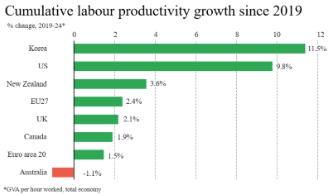
That matters because productivity is ultimately what allows an economy to generate sustainable increases in real wages, household incomes and business earnings. Those fundamentals, in turn, support the capacity of households to service debt and businesses to pay higher rents.
As our original analysis highlighted, scarcity and cheaper credit can lift property prices even when productivity is weak, but stronger household and business incomes provide a more durable foundation for rental and capital growth. - Intergenerational Report high…
So what does this mean for property investors?
It is important not to confuse a weak productivity outlook with a weak property outlook.
Property prices are influenced by a much broader set of forces: land scarcity, population growth, replacement costs, construction activity, credit availability, interest rates and, ultimately, the balance between supply and demand.
Many of those forces remain supportive of well-selected Australian property.
Across a number of the markets in which we are currently operating, available stock remains depleted. Quality assets are tightly held, replacement costs remain high and new development remains difficult to make commercially viable.
That scarcity can support asset values even through periods of relatively modest economic growth.
But it also creates another risk.
When good property is difficult to find, investors can be tempted to compromise on either the asset or the price simply to secure something.
That is where discipline becomes particularly important.
Strategy
Every acquisition needs a clear investment thesis. What is going to drive its performance? It may be land scarcity, rental demand, constrained future supply, demographic growth, redevelopment potential or the underlying utility of the property.
Understanding that before buying is critical.
Asset quality
In a tighter market, investors should not allow scarcity to lower their standards.
We continue to favour property with enduring demand, strong underlying land value or utility and characteristics that are difficult to replicate. The objective is to own an asset that can perform because of its fundamentals, rather than relying solely on the wider market to lift its value.
Price
Perhaps most importantly, a good property is not necessarily a good investment at any price.
The price paid determines the starting yield, cash flow, debt exposure, downside protection and a significant component of the eventual return.
In a market where opportunities are limited, the temptation is to chase. Our view is that this is precisely when valuation discipline becomes more important
Australia undoubtedly needs stronger productivity growth. Sustained improvements in living standards ultimately require the economy to produce more value from the resources and hours worked — something also reflected in the Intergenerational Report.
But the investment conclusion is not to step away from property. It is to become more selective.
Property remains a compelling long-term investment strategy, particularly where supply is constrained and quality assets are difficult to replicate. But in the current environment, investors need to be very clear about what they are buying, why they are buying it and what it is worth.
Strategy and price are always important. In this market, they are absolutely critical.


.png)

.png)
.png)