
Australia's residential property market is undergoing a significant correction.
According to SQM Research, national residential listings reached 276,839 in September 2026, increasing 2.6% over the month and 21.6% over the year.
Properties are taking longer to sell, with the national median selling period reaching 41 days, its highest level since late 2020. Meanwhile, distressed listings reached 4,906 in October, representing an annual increase of 31.7%.
The downturn has become widespread.
Recent realestate.com.au data shows that house values fell across 82.2% of Australian suburbs during the September quarter, while unit values declined across 79.7%.
In Sydney, almost 97% of suburbs recorded declining house values. Across Queensland, 90% of suburbs experienced falls, while in Adelaide, 420 of 462 suburbs recorded declining house or unit values.
These are significant figures.
But for buyers with a long-term investment horizon, the opportunities emerging from this correction are arguably more important than the declines themselves.
The market correction is creating genuine buying opportunities
The extent of the downturn varies considerably between cities, suburbs and individual properties.
According to NAB's October Housing Monitor, dwelling prices have fallen from their respective peaks by:
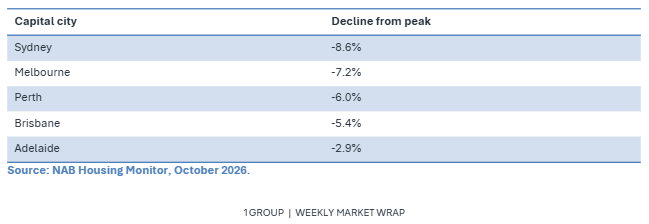
However, these broad market indices do not necessarily reflect the discounts available on individual properties.
In markets such as Brisbane and Perth, where prices rose strongly over recent years, we are now seeing opportunities to acquire individual properties at discounts of 10–15% compared with the prices they may have achieved at the peak of the market.
On a $1 million property, that represents a potential saving of $100,000–$150,000.
These are not market-wide declines, but opportunities emerging where vendors are motivated, properties have remained unsold or previous price expectations are no longer supported by buyer demand.
Melbourne presents a different picture.
While Melbourne dwelling values remain approximately 7% below their March 2022 peak, much of this reflects several years of subdued performance rather than a dramatic correction following a recent boom.
Consequently, the recent adjustment has been less pronounced in many segments, although reduced competition and increased vendor flexibility are still providing buyers with attractive opportunities.
The important distinction is that falling prices do not necessarily make property a less attractive investment. For buyers entering the market, they can substantially improve the investment proposition.
The greatest advantage is access to better-quality property
One of the most important factors in property investment is also one of the least discussed: the difficulty of securing genuinely high-quality assets during a strong market.
When confidence is elevated, buyers compete aggressively for well-located properties. Auctions attract multiple bidders, selling campaigns move quickly and purchasers are often forced to compromise on either the asset or the price.
This is particularly evident in tightly held suburbs where quality properties rarely become available.
A softer market changes that dynamic.
Buyers have more choice, longer assessment periods and greater negotiating leverage.
Importantly, motivated vendors become more willing to negotiate, including on properties that may have attracted substantial competition during stronger conditions.
This creates an opportunity to secure properties with superior fundamentals: stronger land components, better locations, desirable streets, limited competing supply and established owner-occupier demand.
The real opportunity is not simply buying property at a discount. It is buying a better-quality asset at a price that may not have been achievable 12–18 months ago.
For a long-term investor, that difference can be substantial.
Have we already experienced most of the downturn?
While most economists are forecasting further price declines, the latest forecasts suggest that a considerable proportion of the anticipated correction may already have occurred.
Commonwealth Bank and NAB are forecasting the following total peak-to-trough declines:
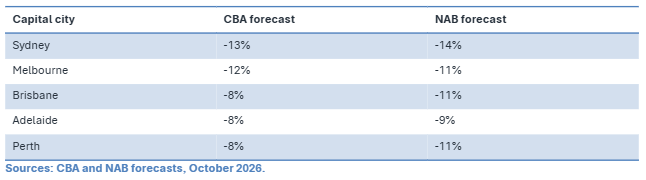
If these forecasts prove reasonably accurate, many markets have already experienced a substantial proportion of their anticipated price declines.
Both banks expect interest rates to have peaked at 4.60%, with the possibility of cuts beginning during the second half of 2027.
CBA is forecasting 50 basis points of reductions in 2027, while NAB expects underlying inflation to moderate to approximately 2.8% and economic growth to reach 1.6%.
Naturally, these projections depend on inflation continuing to ease, unemployment remaining relatively contained and the economy avoiding a recession.
None of this is guaranteed.
However, with prices already materially below their peaks, the potential for interest rate relief and Australia's ongoing underlying demand for housing, there are reasonable grounds for optimism over the medium to long term.
Not all property markets are behaving the same way
Despite the widespread downturn, individual suburbs continue to produce vastly different outcomes.
The original market data highlights extraordinary annual growth in several smaller markets, including:
These figures should be treated cautiously, particularly where transaction volumes are limited and changes in the mix of properties sold can distort median prices.
Nevertheless, they reinforce an important point.
There is no single Australian property market.
Performance varies dramatically between locations, property types and individual assets.
This is why relying exclusively on national forecasts or capital-city averages can be misleading when making individual investment decisions.
The right property can outperform its broader market, just as an inferior property can underperform even during a period of strong market growth.
The right property matters more than the perfect time
Property is fundamentally a long-term investment.
Whether the market begins recovering in late 2027 or takes another year is far less important than the quality of the asset an investor owns over the following 10 or 20 years.
Purchasing a quality property 2% or 3% above the eventual market bottom is unlikely to make a material difference over that investment horizon.
Buying the wrong suburb, street or building is a very different matter.
Those decisions can influence rental performance, tenant demand, capital growth and eventual resale value for decades.
And the consequences compound over time.
Equally, buying a great property does not automatically make it a great investment.
Price remains critical.
Overpaying for a quality asset can undermine returns, particularly in an environment of elevated borrowing costs.
This is why we place such importance on three fundamentals: investment strategy, asset selection and acquisition price.
Each needs to be considered independently.
The best opportunities rarely arrive when confidence is high
There is a contradiction in property investment.
When markets are rising rapidly, confidence is high and buyers feel compelled to act. Yet these are often the conditions in which competition is strongest and the risk of overpaying is greatest.
When markets soften, confidence deteriorates and many buyers retreat.
But for investors with financial capacity and a long-term outlook, these are precisely the conditions that can create opportunity.
During the Global Financial Crisis, investors who purchased quality assets during the downturn, even without identifying the exact market bottom, benefited significantly from the subsequent recovery.
Those who waited for certainty often missed the most attractive entry points.
The same principle applies to residential property.
Buying at the bottom would be ideal, but identifying that point with any confidence is virtually impossible.
Buying a quality property at a sensible price, somewhere around the bottom of the cycle, is a far more achievable objective.
A market that rewards informed buyers
We believe the current market presents a genuine opportunity for disciplined property investors.
Not because we can confidently identify the bottom, but because the conditions required to make a sound investment are becoming increasingly favourable.
There is more stock to assess, less competition and considerably greater scope to negotiate.
For investors with a clear strategy, sound financial capacity and a long-term investment horizon, these conditions deserve serious consideration.
The key is selectivity.
A falling market does not turn a poor property into a good investment, and a discount from an inflated asking price does not necessarily represent value.
The opportunity is to acquire quality property, with strong long-term fundamentals, at a price that supports superior investment returns.
In 10 or 20 years, investors are unlikely to remember whether they purchased six months before or after the market bottom.
They will remember whether they purchased the right property.
Because long-term wealth is not built by perfectly predicting property cycles. It is built by recognising opportunity, remaining disciplined and buying well when others are reluctant to act.
Editorial source note
The 10–15% individual-property discounts reflect 1Group’s observations, rather than independently verified citywide price declines. Exceptional suburb-growth figures are sourced from the original article and should be checked against transaction volumes before publication. Other market statistics and forecasts are attributed in the article to SQM Research, realestate.com.au, NAB and Commonwealth Bank.