.png)
The clouds have gathered and the winds have formed. Batten down the hatches—we’re in for a storm.
According to Cotality, the largest capital-city housing downturn on record, based on 40 years of data, occurred between October 2017 and May 2019, when dwelling values declined by 8.2%.
Capital-city home prices fell by a further 3.7% in the August quarter alone. At a time when living costs, interest rates and taxes are all rising, it is understandably disheartening for property owners that the only thing falling is the value of their investment portfolio.
If the commentators are right, there is more pain to come.
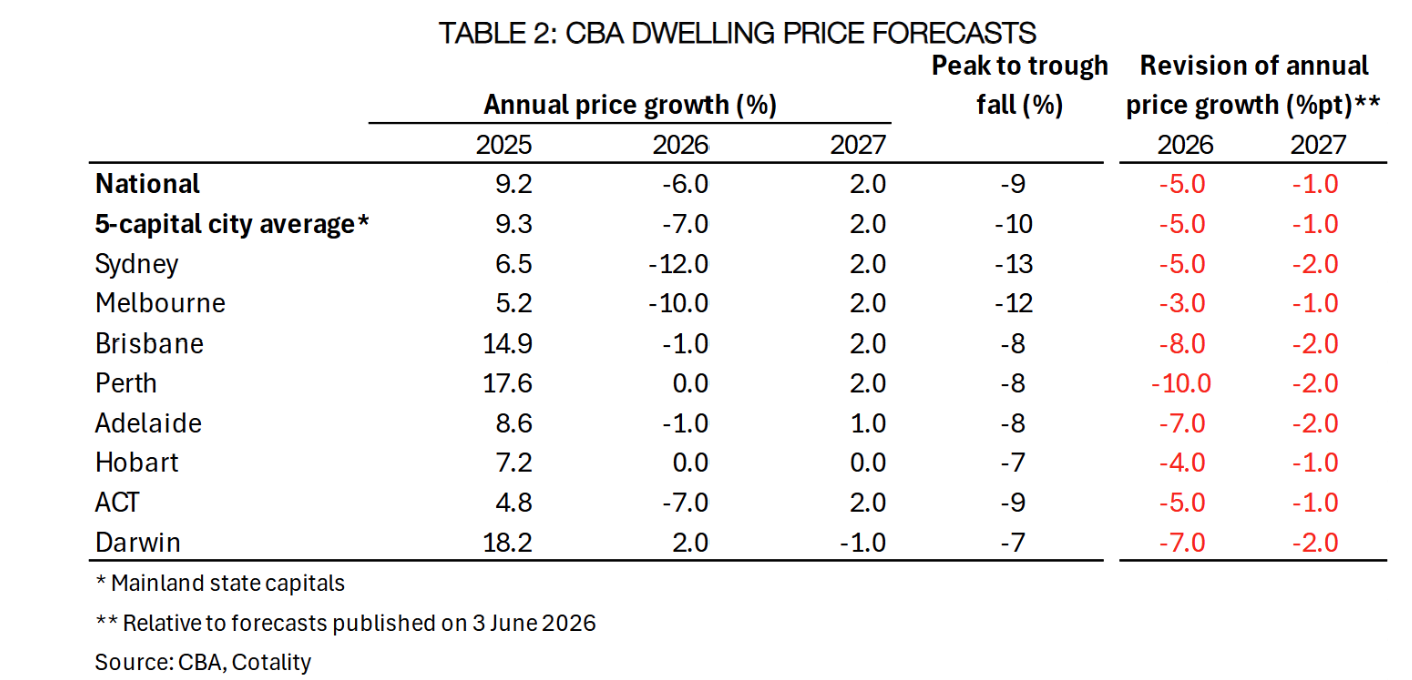
CBA is forecasting a record 10% peak-to-trough decline across the five major capital cities. HSBC has revised its forecast from an 8% decline to 13%, expecting housing and economic growth to continue weakening into 2027.
Macrobusiness economist Leith van Onselen goes further, arguing that property prices must realign with household incomes and pointing to housing declines approaching 20% in New Zealand and Canada.
At the same time, money markets have quickly reversed their earlier complacency. A tight labour market and persistent inflation mean they are now assigning a 72% probability to a rate rise in September. If that does not happen, an increase is expected in November, with a second rise also possible in early 2027.
Who could have predicted that higher interest rates, tax changes affecting investors, new anti-money-laundering obligations for real estate and declining real wages might cause problems for the housing market?
Apparently not Gentlemen Jim and his modelling monkeys in Treasury.
While the outlook is clearly challenging, we also need some perspective.
The biggest price falls so far have been concentrated in the most expensive suburbs of our most expensive cities, along with certain regional markets that ran particularly hard during the boom.
Ray White points to Sydney’s eastern suburbs, where properties valued between $3 million and $7 million have been among the hardest hit. As an agency that claims to sell one in seven Australian homes, it has a meaningful pulse on what is happening on the ground.
Interestingly, Ray White believes prices in this segment have already started to stabilise. The reason is simple: as prices fall, many owners choose not to sell. Unless they are under genuine financial pressure, they would rather sit tight than accept a price well below their expectations.
That does not mean the downturn is over. It does mean that not every homeowner—or every property—will experience the same storm.
I am less concerned about a quality family home in an established, tightly held suburb than I am about high-density housing on the metropolitan fringe, oversupplied apartment markets and properties developed primarily for investors.
These properties are easier to replicate and often have dozens—or even hundreds—of close substitutes. When buyers have plenty of similar options, there is little reason for them to compete strongly. If financially stretched investors begin selling at the same time, prices can fall quickly.
This is why the type of property you own matters just as much as the city or suburb in which you own it.
Properties with genuine scarcity, strong owner-occupier appeal and access to employment, schools, infrastructure and lifestyle amenity should be better placed to weather the downturn.
Clients should also remember that there is a natural floor beneath property prices, and much of it comes back to the cost of replacement.
Land is expensive. Planning and approvals are slow. Building costs remain high, finance is more expensive and many projects are simply no longer commercially viable.
It is difficult for established property prices to remain sustainably below the cost of buying land and building a comparable home—particularly when the population is growing, rental vacancies remain tight and rents are rising.
The next year may be uncomfortable, and some parts of the market are likely to suffer considerably more than others. But this is not a reason to assume all property is bad property.
It is a reminder that in a storm, quality matters. The right property, in the right location, purchased at the right price, will always provide far greater protection than an asset built simply to be sold to the next investor.


.png)

.png)
.png)