.png)
Weekly Market Wrap: Industrial Property—A Good Asset at Any Price?
Industrial property has considerable appeal. Warehouses are generally durable and versatile buildings positioned on relatively large, well-located parcels of land. This allows investors to hold valuable land while receiving a strong rental return.
Quality industrial properties are also tightly held, selling only once every 30 years or so on average. Over time, this combination of land value, rental income and scarcity has produced strong investment returns and helped create intergenerational wealth.
The secret, however, is now well and truly out.
Demand for industrial property is intense, ranging from institutions and high-net-worth investors through to everyday investors buying assets worth a few hundred thousand dollars. The result has been a growing scarcity of quality opportunities and a significant compression in yields.
As the chart below demonstrates, industrial property values have increased by approximately 365% since 2000, while average yields have fallen from around 11% to below 5%.
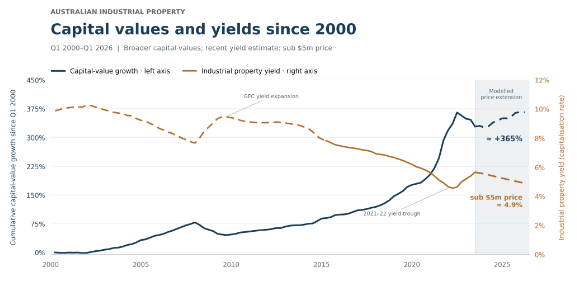
In simple terms, investors are now paying considerably more for each dollar of rental income—and some appear willing to compromise on the quality of the property simply to enter the market.
My spider senses start tingling when any market shows signs of exuberance.
There is no doubt that the cost of replacing industrial property continues to rise, which provides some support for values. However, interest rates and bond yields are also increasing. Investors therefore need to ask some basic questions.
Why would a passive investor accept a yield of 5% or less from a property carrying leasing, maintenance and capital risks when a 10-year Commonwealth Government bond is yielding around 5.36%?
Why take on substantially more debt when borrowing costs are rising?
Most importantly, why buy a secondary industrial asset that could be among the first to become vacant during a recession, the last to lease during a recovery and the most likely to require ongoing structural repairs?
Over time, rents should rise and capital values may increase. There may also be negative-gearing benefits along the way. However, commercial property carries genuine risk, and as the economy appears to be sliding towards recession, optimism needs to be balanced with caution.
At 1Group, we will not compromise on building quality, location or an acceptable rental yield. Over the past three weeks, four of my offers have been declined because competing buyers were prepared to pay above our assessment of fair value.
That can be frustrating, particularly in a market where good opportunities are difficult to find. But our clients honour us with their trust and pay us to exercise good judgement—not simply to secure the next available property.
It is often said that it is better to pay a fair price for a good property than a good price for a fair property. I agree. However, even a good property can become a poor investment when too much is paid for it.
Being willing to walk away from a bad deal is just as important as recognising a good one.
Unfortunately, not everyone appears to follow these principles. As more buyers’ agents pivot from residential into commercial property, a lack of experience and genuine client consideration is becoming increasingly apparent. Some advisors seem more focused on completing the transaction than considering how the asset will perform through different market conditions.
Industrial property remains an excellent asset class—but not every warehouse is a good investment, and no asset is worth buying at any price.
In commercial property, the cost of poor advice can far exceed the fee for good advice.


.png)

.png)
.png)