A client recently asked us an interesting question: “If residential property values have been falling, hasn’t the same thing happened to commercial property?”
It’s a reasonable question, but the answer highlights an important distinction between the two asset classes.
Residential property is largely driven by affordability, location and buyer demand. Commercial property, particularly industrial, is valued primarily on the income it generates and the risk associated with that income.
Understanding this difference is essential.
As interest rates rise, commercial property investors typically demand higher yields to compensate for increased borrowing costs and risk.
Ordinarily, higher yields translate into lower property values, assuming rental income remains unchanged.
Yet industrial property has been surprisingly resilient.
Rental growth, constrained supply in established industrial precincts and annual increases built into many commercial leases have helped offset the impact of higher interest rates.
The numbers tell an interesting story.
In the $10 million-plus institutional industrial market, national super-prime capitalisation rates increased just 11 basis points, from 5.70% to 5.81%.
Rents needed to increase approximately 1.9% to maintain property values. After incentives, effective rents increased 1.3%, implying a relatively modest 0.6% decline in values.
The smaller industrial market has performed differently.
For properties below $3 million, capitalisation rates compressed approximately 12 basis points, from 4.75% to 4.63%, reflecting strong competition from private investors and owner-occupiers.
Combined with assumed rental increases of 3%–4%, this implies capital value growth of approximately 5.7%–6.7% in 2026.
These are indicative valuation movements based on changes in yields and rental income, rather than measured growth across every property.
The following figures highlight the differences between strata and freehold industrial assets across four major markets.
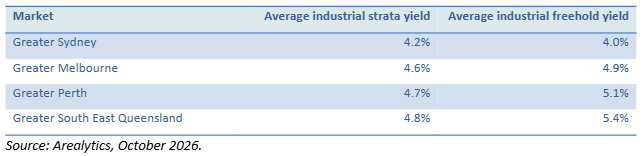
Importantly, Melbourne, Perth and South East Queensland are offering higher average yields on freehold industrial assets than Sydney.
However, yield alone should never determine an investment decision.
Industrial property isn’t immune to economic conditions.
If higher interest rates persist and economic activity weakens, businesses may come under pressure. This can translate into increased vacancies, slower rental growth and potentially declining property values.
More importantly, two industrial properties offering the same yield can have vastly different risk profiles.
Tenant quality, lease terms, building functionality, location, future rental demand and the ability to secure another tenant all influence long-term performance.
An attractive yield can quickly become irrelevant if the tenant vacates and the property proves difficult or expensive to re-lease.
This is why understanding the underlying asset is just as important as understanding the numbers.
We remain strong advocates for industrial property as part of a well-constructed investment portfolio.
The combination of rental income, potential capital growth and favourable lease structures can make it an excellent long-term wealth creation strategy.
But industrial property is a specialised asset class. Buying the wrong property, accepting the wrong lease or simply paying too much can undermine years of investment performance.
At 1Group, we believe the opportunity lies in identifying quality assets, understanding the risks and negotiating acquisitions at the right price.
Whether you’re considering your first industrial investment, expanding your portfolio or reviewing an existing asset, our team can help you assess the opportunity and develop the right strategy.
Industrial property should be part of the conversation when building your investment portfolio. But with significant capital at stake, expert advice and disciplined due diligence aren’t optional — they’re essential.
If you’re considering an industrial acquisition or would simply like an independent assessment of your current portfolio, feel free to reach out. We’re always happy to have a conversation.