
Victorians head to the polls on 28 November with the prospect of a change of government becoming difficult to ignore. The latest RedBridge/Accent poll puts Jess Wilson’s Liberal–National Coalition ahead of Labor 57% to 43% on a two-party-preferred basis.While the result is not settled, the property implications deserve attention. Tax settings, planning controls and infrastructure spending all influence where value is created—and which assets benefit.
The Coalition’s Key Property Commitments
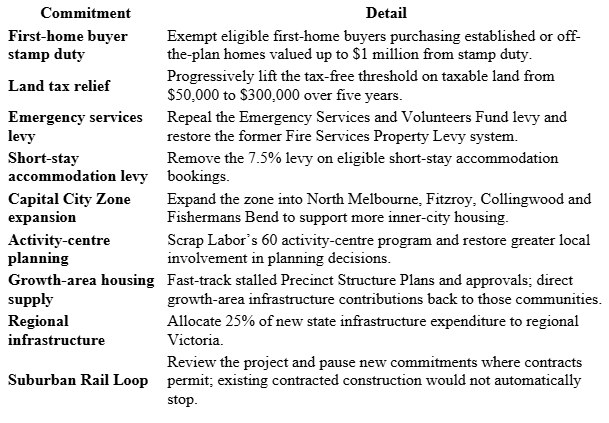
These are election commitments, not changes to current law. Timing and implementation remain subject to government decisions and legislation.
Labor has finalised new planning controls across 60 train and tram activity centres, with capacity for more than 300,000 additional homes by 2051. The Coalition proposes to scrap this program, favouring greater local input and additional inner-city development through an expanded Capital City Zone.
That could create opportunities for older commercial properties and underutilised sites in inner Melbourne. But for owners benefiting from recently introduced activity-centre controls, a policy reversal could also create uncertainty. Existing zoning and development rights would not disappear simply because the government changes.
The Coalition’s approach to the Suburban Rail Loop adds another consideration for property owners near proposed stations, while faster land release and increased regional infrastructure spending could change the outlook for selected growth corridors and regional centres.
The proposed stamp duty exemption is significant for first-home buyers, potentially saving up to $55,000 on an eligible purchase. It is not, however, a general stamp duty reduction for established buyers or investors.
Restoring the land tax threshold would reduce holding costs for some investors. Importantly, Labor has also committed to restoring a $300,000 threshold, although the proposed timetables differ. Repealing the short-stay levy would be particularly relevant to holiday accommodation markets.
Tax cuts can encourage demand as well as investment. In some markets, part of the benefit may ultimately be reflected in higher purchase prices.
Perhaps the most immediate benefit from the election will be the removal of uncertainty itself. When the policy direction is unclear, buyers delay decisions, developers defer projects and investors hesitate to commit capital.
Regardless of who forms government, the result should bring greater clarity and, in our view, renewed confidence. A Coalition victory could provide an additional catalyst through tax relief and planning reform, but those measures would take time to implement.
At 1Group, we continue to see opportunities where subdued competition allows buyers to negotiate more effectively. The key is not to buy on the expectation of a policy windfall, but to secure an intrinsically strong asset at the right price, supported by sound strategy and comprehensive due diligence.
Elections can change policy. Long-term wealth is still created by buying well.