
Five interest-rate increases have taken the RBA cash rate from 3.60% to 4.85% this year. But higher borrowing costs are not the only reason property has struggled.
Labor's May Federal Budget introduced significant changes to negative gearing and capital gains tax, creating uncertainty around investment returns, ownership structures and future acquisition strategies.
From July 2027, negative gearing against other income will generally be restricted to eligible new residential builds, with existing investments protected under grandfathering arrangements.
Combined with higher rates, these changes have encouraged many investors to reassess their strategies or remain on the sidelines.
But how has property actually performed relative to other investments?
How Have Different Investments Performed in 2026?
2026 year-to-date asset performance in Australian dollars, including capital gains and income:
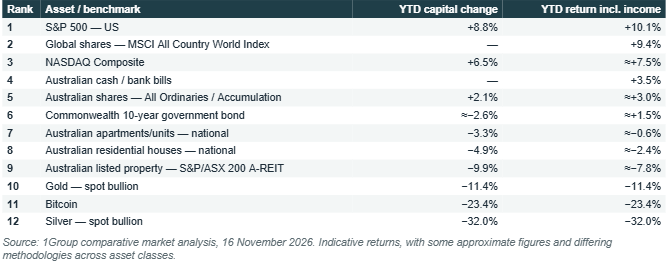
The results are revealing.
While international equities have performed strongly, Australian residential property has held up relatively well. National houses have returned approximately −2.4% including income and apartments −0.6%, compared with −7.8% for listed property trusts, −11.4% for gold and considerably greater losses for Bitcoin and silver.
Cash, bonds and Australian shares have delivered positive returns, but the correction in direct property has been relatively moderate compared with several other investments.
It is an important reminder that investment performance should be assessed over multiple market cycles, rather than a single year.
Why Property Remains a Powerful Wealth Creation Strategy
Property offers investors three important advantages.
Rental income: A well-selected property generates ongoing income, helping offset financing and holding costs. As rents increase, cash flow can improve over time.
Capital growth: Quality property benefits from land scarcity, population growth, rental demand and increasing replacement costs, supporting long-term capital appreciation.
Leverage: Perhaps property's greatest advantage is the ability to control a substantial asset with a relatively small equity contribution.
Consider a $1 million property purchased with $200,000 in equity and an $800,000 loan
A 5% increase in value represents a $50,000 capital gain, equivalent to 25% of the original equity invested, before financing, transaction and holding costs.
That is the power of leverage.
While other investments also offer income, growth or leverage, property's appeal lies in the ability to combine all three within a long-term wealth creation strategy.
Market Weakness Is Creating Opportunity
The current correction has not been uniform. Our analysis shows capital-city houses have declined 6.9% this year, with Sydney houses down 11.1% and Melbourne houses 9.0%.
Melbourne is particularly interesting because prices had already experienced years of subdued growth.
This relative value is increasingly difficult to ignore.
According to PropTrack, Melbourne property values are 3.5% below where they were five years ago, compared with increases of 54.6% in Brisbane and 74.8% in Perth.
Across multiple markets, reduced competition and greater vendor motivation are allowing financially prepared investors to negotiate prices and terms that were difficult to achieve during stronger market conditions.
The Opportunity Before the Recovery
There may still be further weakness ahead. However, property markets move through cycles, and today's uncertainty will not last indefinitely.
When interest rates eventually fall, improved borrowing capacity and renewed confidence should support a recovery in demand. Combined with housing shortages, rental growth and elevated construction costs, the longer-term fundamentals remain compelling.
At 1Group, we believe successful property investment is not about predicting the precise bottom. It is about identifying quality assets, understanding their income and growth potential, and acquiring them at the right price.
The strongest investment opportunities aren't always found in the assets topping this year's performance table. They often emerge when sentiment is weak, competition is limited and quality assets can be acquired at attractive prices.
For property investors, the opportunity today is to combine rental yield, long-term capital growth and the power of leverage — while securing an entry price that could make all three work considerably harder over the next decade.